

In the early 2010s, enterprise IT leaders ran into a hard truth: when workplace technology lagged too far behind what people used at home, employees simply routed around IT.
They brought iPhones and Android devices into BlackBerry shops. They signed up for consumer cloud tools when corporate collaboration platforms were too clunky. They used personal laptops and tablets because they were faster and more pleasant.
Attempts to ban this behavior mostly failed. The gap between consumer and enterprise tech became so wide that organizations were forced into a new model: Bring Your Own Device (BYOD). For many enterprises, BYOD wasn’t visionary; it was defensive—an attempt to stem attrition, boost productivity, and reduce shadow IT.
We’re now at a similar inflection point. The difference is that this time, the devices matter less than the intelligence running on them.
Employees have powerful general-purpose AI agents in their pockets: ChatGPT, Claude, Gemini, etc. They use them at home to draft emails, summarize documents, debug code, learn new topics, and automate routine tasks. Then they come to work and are told: “You can’t use that here.” or at best, given inferior, knee capped, versions to struggle with.
This is the End User AI gap. If organizations repeat the mistakes of pre‑BYOD IT, they’ll see the same pattern: shadow usage, lost productivity, and an avoidable drain of key talent. The risk of “Bring Your Own Agent” becoming the de facto reality is now greater than the risk of intentionally rolling out robust, governed AI tools across the enterprise.
If BYOD was about physical endpoints, End User AI is about cognitive endpoints. The parallels aren’t hard to find. Outside work, people now routinely use generative AI to draft and refine emails and documents, summarize content, generate code, research and learn new topics, and automate tasks.
Meanwhile, inside many enterprises, access is blocked outright or limited to narrow pilots. And when AI tools are provided, they are often less capable and less usable than what’s available publicly.
When employees feel constrained at work but empowered at home, behavior starts to look very familiar:
1. Shadow AI usage - Employees use personal devices and accounts for work prompts (“I’ll just paste this into my personal ChatGPT and see what it says”). They strip out obvious identifiers but often underestimate how much context is still sensitive.
2. Fragmented workflows - Work happens in a patchwork: some pieces in enterprise systems, some through personal AI tools, some copied manually between the two. There’s no audit trail or central visibility into how decisions are being supported by AI.
3. Divergent productivity levels - Employees who use AI personally but feel constrained at work know it could be easier. They will eventually ask why it isn’t or go somewhere it is.
4. Policy theater - “No AI” rules that can’t be enforced create cynicism. Everyone knows the rules are being bent. Security and compliance teams are flying blind.
The question isn’t whether or not enterprise end users will use AI. It’s simply how.
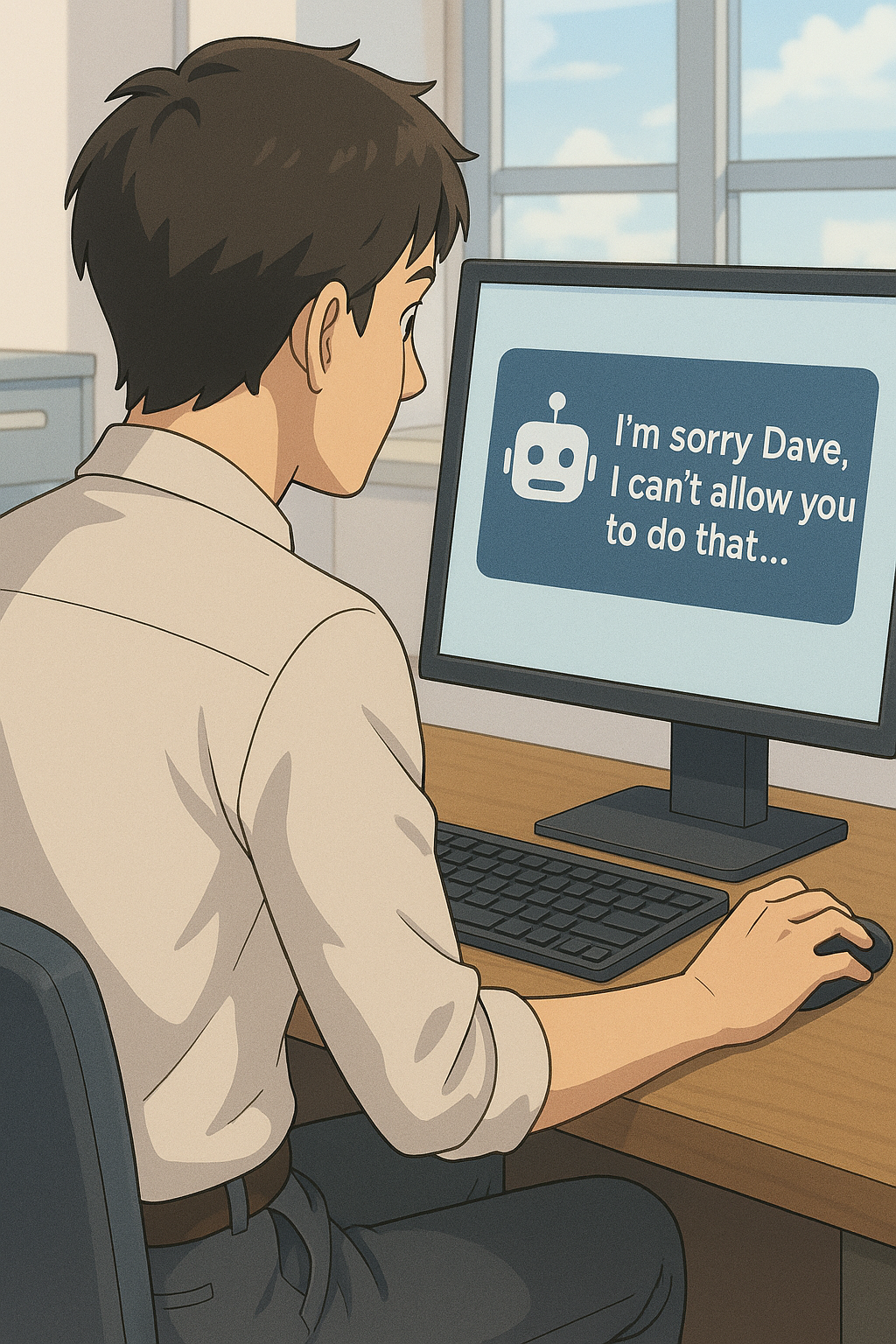
It’s easy to frame AI risk as a reason to wait: hallucinations, data leakage, regulatory uncertainty, IP exposure, bias. Those are all real.
But there’s a quieter, more structural risk in slow‑walking End User AI adoption: building an organization whose human workflows are systematically uncompetitive.
The productivity gains we saw with BYOD are modest compared to what we’re starting to see with End User AI where tasks that previously would take hours can be done in minutes, routine work can be fully automated, and underlying paradigms for work are being redefined.
If your competitors normalize these changes across their workforce while you confine your teams to a handful of pilots or a single niche copilot, you are effectively choosing to operate with a persistent productivity tax.
From a risk perspective, the relevant choice isn’t “AI or no AI.” It’s what kind of environment you’re willing to own
End User AI is the latest iteration of the same pattern that triggered BYOD. Just with higher stakes. The gap between what people can do with AI in their personal lives and what many can do inside the firewall is already large and growing. It shows up as:
- Lost productivity, as manual work persists where it could be assisted.
- Increased risk for security and compliance, as “shadow AI” fills the void.
- Talent loss, as the AI fluent employees leave for more modern environments.
Enterprises that respond with “no” or “not yet” risk becoming the Internet Explorer shops of the AI era—pushed into a rushed, painful transition later, after competitors have already reaped the benefits.
The alternative is to treat End User AI the way enlightened CIOs came to treat BYOD: as an inevitable, powerful trend that has to be shaped, not suppressed. That means empowering and harnessing end user AI across the organization, designing for security and compliance at the data, identity, and application layers, and continuously listening, measuring, and iterating as the technology changes.
There’s one simple conclusion. The risks of inaction: attrition, shadow AI, and uncontrolled “bring your own agent” behavior, now exceed the risks of a deliberate, well‑governed rollout. Closing the End User AI gap is not just an IT initiative; it’s a strategic imperative.
Build with Connectifi and let us help you, accelerate time to value, remove complexity, and reduce costs. Talk to us now.
%20(2).png)


